Flea & tick yard neutralization addresses outdoor parasite clusters before biting vectors attach to pets or enter residential living quarters. In communities like DC Ranch, McCormick Ranch, and Gainey Ranch,…
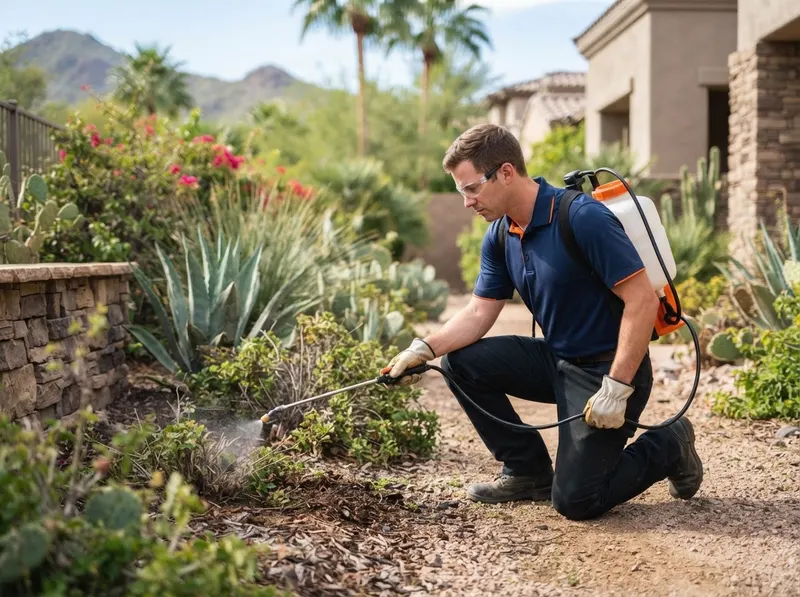
Flea & tick yard neutralization addresses outdoor parasite clusters before biting vectors attach to pets or enter residential living quarters. In communities like DC Ranch, McCormick Ranch, and Gainey Ranch, micro-climates created by automated subsurface drip lines and irrigated hybrid Bermuda turf allow flea pupae to survive severe Maricopa County summer heat. In northern desert areas like Troon North and Desert Mountain, wildlife vectors such as coyotes, desert cottontails, and javelinas drop brown dog ticks (Rhipicephalus sanguineus) along natural wash borders and rear block walls. Yard neutralization breaks this biological chain by introducing an adulticide paired with an insect growth regulator (IGR) across shaded resting zones, under desert ironwood canopies, and within decorative decomposed granite beds.
Selecting standalone outdoor neutralization fits properties where pets spend routine time outdoors, contrasting with broad-spectrum interior pest treatments that only address indoor harborages. The primary operational trade-off centers on mechanical surface preparation versus residual protection length: granular and micro-encapsulated liquid barriers require dry, clear turf beds to bond effectively with soil matrices, which temporarily requires pets and family members to stay off treated damp surfaces for approximately two hours until complete drying occurs. An initial spray without an accompanying insect growth regulator leaves behind viable flea cocoons that emerge within 14 to 21 days; combining pyrethroid or targeted essential-oil barriers with pyriproxyfen arrests juvenile molting stages directly on exterior soils.
Property owners in Silverleaf and Grayhawk with low-water xeriscaping frequently discover ticks nesting within the mortared crevices of Sonoran boundary walls or sheltered underside cavities of synthetic turf installations. Yard treatment targets these high-heat harborages using pressurized directional nozzles, preventing off-target drift onto delicate agave or citrus specimens. Every deployment requires an on-site evaluation to identify specific animal transit runs and verify structural clearances, establishing a protective exterior shield without binding homeowners to open-ended, automatic-renewal contracts.
Every job gets a firm, written price after a free on-site visit.
Tell us about your flea & tick yard neutralization job in Scottsdale and we'll send a clear, written quote, usually the same day.
 Desert Finch Pest Control